|
Perspective
By Rich Checkan
In 2022, central banks started buying gold in a meaningful way. They purchased over 1,000 metric tons that year. They did it again in 2023. They did it again in 2024. Last year, they purchased 860 metric tons.
Prior to 2022, and going back fifty years, the annual high-water mark for central bank gold buying was 500 to 600 metric tons.
All that buying had an impact on the gold price… $1,700… $2,400… $3,000… and earlier this year… $5,500.
The buying started when interest rates were near zero. The buying continued as governments around the world raised interest rates in order to subdue inflation. (The peak for the United States was 5.25%.) The buying continued as interest rates were cut, starting in late 2024.
The buying continues now with U.S. interest rates at 3.5% to 3.75%.
Yet, over the past four years, every time I hear a discussion about the gold price, I hear the following phrase uttered in some form or fashion…
“Higher interest rates are typically bearish for gold, making the yellow metal a less attractive alternate investment than other assets.”
The suggestion is basically that gold simply cannot move higher in price unless the Federal Reserve lowers interest rates.
I could not disagree more.
All FED Up
I believe we give the Federal Reserve way too much credit.
I am not doubting the Federal Reserve is made up of brilliant economists who mean well. However, I do doubt that they have the understanding and the tools to drive inflation down to their target of 2%.
We may cover that at another time.
Today, I want to address my biggest frustration with all this hype about what the Federal Reserve will or will not do with interest rates. That is, at these levels, it should have no impact on the price of gold whatsoever.
The current Fed Funds Rate is 3.5% to 3.75%.
The current Consumer Price Index (CPI) is 3.01%.
That means, if you could get your bank to pay you the effective funds rate of 3.5% - which you probably cannot – your Real Rate of Return on your term deposit would be one half of one percent.
That is it… a rounding error!
I ask you… Is that enough of an incentive to keep you from taking that money out of a term deposit and purchasing gold?
It is nowhere near enough to dissuade me from buying gold.
Here is why…
The FED Is Powerless
Jerome Powell, Kevin Warsh, and their merry band of economists absolutely cannot solve the problem plaguing our economy and the U.S. dollar.
Here is Exhibit A from Hugh Cameron at Newsweek…
“The United States national debt has now grown beyond the size of the country’s GDP, punctuating a long-running trajectory that has left budget hawks skittish, but Congress appears uninterested in countering.
According to advance estimates released Thursday by the Bureau of Economic Analysis (BEA), America’s gross domestic product (GDP) totaled $31.22 trillion over the 12 months to March 31, now slightly under the $31.27 trillion in debt held by the country at the end of this quarter.”
The United States does not have an interest rate problem. Rates are at some of the lowest levels we have ever seen historically.
Our problem as a nation is fiscal irresponsibility.
Until Congress passes a balanced budget and the President signs it, we will continue to add to our out-of-control debt. That out-of-control debt leads to monetary expansion (the true definition of “inflation”).
The expanded money supply leads to price inflation for anything (goods or services) of any value. As more diluted U.S. dollars chase a finite number of goods and services, prices will increase.
As long as Congress continues to overspend, it absolutely does not matter what the Federal Reserve does with interest rates. Prices will climb. Gold will cost more per ounce.
At a bare minimum, we need to see high single-digit to low double-digit interest rates to cause investors to start to consider taking funds out of gold and putting them in term deposits at a bank.
But, even at those levels, I think it would be a mistake to do so.
The interest on our gargantuan debt is already the largest line item in the budget. And that is with interest rates at 3.5%.
At these low levels, less and less investment is going into mismanaged Treasuries. This causes us to buy our own debt with money we do not have. That leads to further monetary expansion… and the vicious cycle continues.
The Fed cannot fix what Congress has broken.
Our good friend Chuck Butler, founder and author of The Daily Pfennig, expressed his frustration in Monday’s e-letter…
“Speaking of picking a lane! Up one day, down the next... it shows me that there's no clear view on the direction of Gold & Silver right now... In fact, to me all the attention has shifted from the metals to Oil, and that's causing this back and forth in the metals... Hey! Ahem! Look over here at me! I'm still being bought by Central Banks! Hey, focus your attention over here... That's what Gold & Silver are saying these days...”
I could not agree more.
Ask Yourself This…
If interest rates are so bearish for gold at 3.5% to 3.75%, why were central banks buying gold hand over fist at 5.25%?
Why do central banks continue to buy at historic levels today?
Chuck is constantly asking his readers, “Got Gold?!?”
For the world’s central banks, the answer is a resounding, “Yes!”
I strongly suggest you follow their lead.
I said the following when gold was at $1,700, $2,400, and at $3,000…
“Gold is dirt cheap… and silver is even cheaper.”
I am shouting that again today for anyone who will listen. It is time for you to become your own central bank, and we can help you get started.
Send us an email. Call us toll free at (800) 831-0007.
I am with you Chuck… Got Gold?!?
—Rich Checkan
Editor's Note: Porter Stansberry, Founder and Chairman of Meadowdale Holdings, has been rewriting the rules of financial publishing for over 25 years. This article was originally published in Porter Stansberry's Daily Journal on March 30, 2026. To subscribe to this free daily newsletter, click here: https://join.portersdailyjournal.com/
Feature
When To Buy Gold
By Porter Stansberry
An Update On Our Gold-Pricing Model
In the mid-1990s, I met the last of the great pre-war, Austrian economists, Kurt Richebächer.
At the time I was a young equity analyst working for Bill Bonner. He’d recently bought The Fleet Street Letter and named me its editor. We were hosting a conference of the world’s top Austrian economists in Washington, D.C., to announce the launch of The Fleet Street Letter in the United States. Kurt was our keynote speaker. I picked him up from the airport and we spent the day together. He was an incandescent genius. And I was a sponge.
That began a decade-long friendship that lasted until his death in 2007.
In addition to being an academic economist, Richebächer was also chief economist of Germany’s Dresdner Bank. Like all Austrian school economists, he understood that credit, not money supply, is the true measure of inflation. Currencies are inflated when outstanding debt grows well beyond increases to economic activity (GDP) and productivity. The resulting increase to prices – what most people think of as inflation – only happens later (creating the Cantillon Effect) and dynamically, depending on a myriad of factors.
Gold, in Richebächer’s framework, is the real monetary base. It is the one thing that cannot be manufactured by a central bank or conjured into existence by a lending officer. Every other currency in the system is someone’s liability. Gold is no one’s liability. Gold is a physical proof of work that can only be created with labor, capital, and energy inputs. Thus, it is the natural reserve of the economic system. (Richebächer died before Bitcoin was invented. Bitcoins are also a proof of work. They require labor, capital, and energy inputs to be created.)
Money supply – M2, M3 – only captures a fraction of total dollar-system leverage. It counts cash, checking accounts, savings accounts, and some short-term instruments. But it misses the vast ocean of credit that sits outside the banking system’s deposit base: the $39 trillion in federal government debt, the trillions in corporate bonds held by pension funds and insurance companies, the $14 trillion in offshore dollar-denominated loans and bonds extended to borrowers in Brazil, Europe, and Asia. None of that shows up in M2. But all of these “invisible” dollars represent claims on future production, promises that will need to be honored, rolled over, or inflated away.
Richebächer’s Austrian school insight was that gold prices respond to the total stock of dollar-denominated promises, not just the narrow money supply. When you measure credit instead of money, you capture the full weight of the dollar system — every mortgage, every Treasury bond, every eurodollar loan. That is what gold is really pricing: the sheer mass of dollar obligations relative to the one asset that cannot be diluted.
This is why models built on M2 struggle to explain gold’s behavior from 2020 to 2026. M2 actually shrank in 2022 and 2023 as the Fed tightened. If money supply were the right variable, gold should have fallen. It didn’t. It kept climbing — because total credit never stopped growing. The government kept borrowing. Companies kept issuing bonds. Offshore dollar lending kept expanding. The credit machine never turned off. And gold, priced against that credit, kept rising.
Understanding the gold price – and being able to predict it accurately – is one of the oldest and most valuable secrets in the world.
For centuries, the ability to build a credit-based model was impossible because the data required to calculate global credit growth was a closely guarded secret. By aggregating this data, and keeping it secret, the world’s most powerful bankers (the Medicis, the Rothschilds, the Warburgs, the Morgans, etc.) could accurately predict future asset prices, such as real estate and commodities, currency exchange rates, and, most importantly, gold.
We’ve built our own global credit database that measures how much total dollar-based credit exists in the world and how much it’s growing (or shrinking) each month. Our database has two core parts: domestic credit and offshore credit.
Domestic credit is all the borrowing done by the U.S. government, U.S. households, and U.S. companies. It does not count borrowing between banks or financial firms – just the regular economy. This data comes from an organization called the Bank for International Settlements (“BIS”). You can also find this data on the Federal Reserve’s website under the code QUSCAMUSDA. As of Q3 2025, domestic credit stood at about $76 trillion. But there’s a key caveat to this data source: the BIS only releases this data after a six-month delay. (Mmmm….)
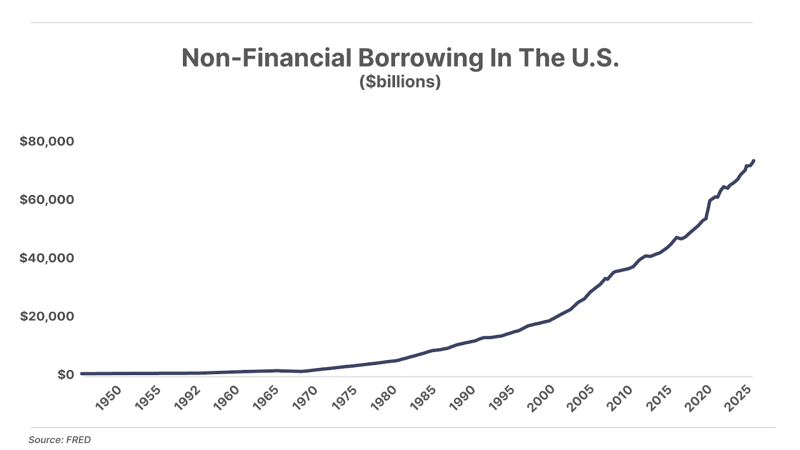 Offshore credit is dollar-denominated borrowing by people and companies outside the United States, like a Brazilian company taking a loan in dollars. Or a European government selling a bond priced in dollars. The BIS tracks these loans, too. As of Q3 2025, offshore dollar credit stood at about $14.2 trillion. Offshore credit is dollar-denominated borrowing by people and companies outside the United States, like a Brazilian company taking a loan in dollars. Or a European government selling a bond priced in dollars. The BIS tracks these loans, too. As of Q3 2025, offshore dollar credit stood at about $14.2 trillion.
Thus, there’s roughly $90 trillion in total dollar credit. To make this easier to track over time, we turned that number into an index. We set it equal to 100 as of March 2009 – the very bottom of the Global Financial Crisis, when things looked bleakest. Today, that index stands at 216. In plain English: total dollar credit has more than doubled since the crisis. And… the rate of credit growth has exploded since COVID.
Before COVID – from 2010 to 2019 – U.S. credit grew by about $2 trillion per year. Then COVID hit. From 2020 through 2025, U.S. credit has been growing at about $3.6 trillion per year. That is nearly double the pre-pandemic pace. The system never went back to normal. It shifted into a higher gear and stayed there.
Why hasn’t it slowed down? There are four reasons.
1. The government went on a borrowing spree. The U.S. government alone added over $10 trillion in new debt since mid-2020. The federal deficit – the gap between what the government spends and what it collects in taxes – has been running above 6% of GDP.
2. Inflation made every loan bigger. When prices rise 20% to 30% – as they have, cumulatively, since 2020 – every single loan gets bigger in dollar terms. More credit is created even if the exact same number of loans are made. Inflation inflates the credit numbers automatically.
3. Refinancing: when homes and businesses got reappraised at higher values, people refinanced. They took out bigger loans because their collateral – the stuff they own – was worth more in dollar terms. Companies did the same thing, rolling over old debt at higher nominal amounts. Each refinancing created a little more credit.
4. Offshore dollar credit is re-accelerating. After pulling back during 2022 and 2023, when interest rates rose sharply and the dollar got stronger, foreign borrowers are jumping back into dollar debt. Offshore U.S. dollar credit is now growing at 7.3% year-over-year, the fastest pace since 2021. Why? Because the dollar has weakened recently, which makes it cheaper for foreign borrowers to take on dollar-denominated loans. When dollars are “on sale,” the world borrows more of them.
I’ve been warning about a pullback in gold’s price because it had run far beyond our model’s predicted range and because, with the trouble in private credit, I was expecting credit to contract, not to continue growing. Those risks are still out there, but… so far… there’s absolutely no sign that, overall, credit growth is slowing.
How do we know? It’s not from the BIS data that powers our model. The most recent BIS numbers cover Q3 2025. So how do we know what is happening right now?
To see what’s happening now in credit issuance, we use a different data source, the U.S. Federal Reserve. Each week, the Fed publishes a report on outstanding bank loans and you can find it on the Federal Reserve’s website under the code TOTBKCR. It covers every loan and every security held by commercial banks across the country.
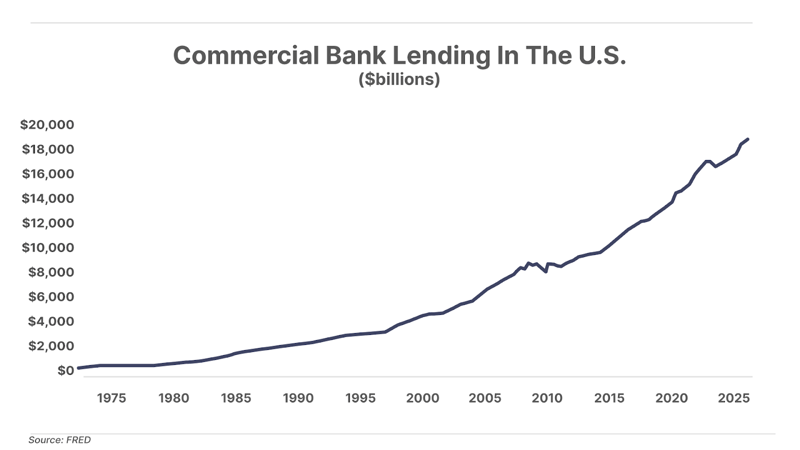
This report covers almost $20 trillion in lending, which is far from a complete view of the credit markets. But changes in credit happen in this category first. When credit starts picking up or slowing down, the banking system usually shows it before the other sources of credit. And right now, that front edge is very clear: bank credit growing at 6.5% year-over-year, the fastest pace since early 2023. This is not a credit system that is slowing down.
What does this tell us? When the BIS eventually publishes its Q4 2025 and Q1 2026 data later this year, it will almost certainly show the same thing: U.S. dollar-based credit growth is re-accelerating. Not slowing down. Not “normalizing.” Speeding up.
When dollars are created through lending at a much faster pace than increases to production (GDP) and growth in productivity, the result is inflation. Each existing dollar becomes a little less special. Their purchasing power erodes over time.
Gold is a natural reserve of economic value. You cannot print gold: you have to mine it with labor, capital, and energy. When there’s credit inflation, the price of gold will move higher. But there’s a catch: it does not happen right away. It takes time to impact gold prices. Historically. there’s a lag of roughly three years between when credit accelerates and when gold prices fully reflect it.
Why three years? The Cantillon Effect. When new money is first created, it typically goes into business investments. Businesses hire workers, buy equipment, pay contractors. Then as all that spending ripples through the economy, prices start to rise. Then people start to notice that inflation is not going away. Then central banks and large investors start buying gold to protect themselves.
I’ve modified Richebӓcher’s model in one important way.
Most people don’t know that former Fed Chair Alan Greenspan was an Austrian. He understood gold’s role in the world’s economy. Although he almost never spoke about gold publicly, in private, he explained its role in the world economy with great clarity.
"The financial policy of the welfare state requires that there be no way for the owners of wealth to protect themselves… Deficit spending is simply a scheme for the “hidden” confiscation of wealth. Gold stands in the way of this insidious process."
In 1999, Greenspan gave a secret presentation to a select group of bankers in Washington, D.C., about the stability of the global dollar-based financial system. He’d developed an objective measurement – which I’ll call the Greenspan Test – that’s based in part on gold, that captures the overall risk inherent in the dollar-based financial system.
This is not about day-to-day market stress or volatility. It is about whether the architecture of the global dollar system as a whole will remain stable. The Greenspan Test measures the relationship between what America owes foreign creditors in the short term and what it holds in reserve. When the Greenspan Test reaches crisis levels, gold’s price can increase well beyond normal model ranges because the entire system is at risk of collapse.
Currently, the credit inputs for gold’s price are modest (8.9% cumulative three-year growth). The standard model would say gold should be in the $2,800 to $3,400 range. But gold is at $4,600. And our adjusted model says the bottom of gold’s range is now around $4,000.
Let’s walk through the model’s standard components.
The single most important variable is three-year cumulative credit growth. This measures how much total dollar credit expanded over the prior three years. The bigger that number, the higher the model predicts gold will go. It is the engine of the whole thing.
The second input is real interest rates – that is, interest rates after you subtract inflation. When real rates are low or negative, gold becomes more attractive. There is no “opportunity cost” to holding it because bonds and savings accounts are not paying much either. When real rates are high, gold gets dragged down because investors can earn real returns elsewhere.
Third is the dollar index – a measure of how strong or weak the dollar is against other currencies. A weaker dollar tends to push gold higher, both because it makes gold cheaper for foreign buyers and because dollar weakness signals trouble for the currency itself.
Now here is where it gets very interesting. The three-year credit growth inputs feeding into this model are accelerating rapidly:
As of Q3 2023, the three-year cumulative credit growth was 8.9%. That number feeds the model’s gold price estimate for 2026. As of Q3 2024, that same figure had grown to 10.7%, which feeds the 2027 estimate. As of Q3 2025, it jumped to 14.4%, which feeds the 2028 estimate. And by our estimate for Q3 2026, the three-year cumulative credit growth could reach 17% to 19%, feeding 2029’s range.
Each year, the credit impulse feeding future gold prices gets larger.
The machine is not winding down. It is winding up. And something is driving gold’s price even higher than the standard Austrian model would predict. That’s the system risk factor in play.
So where is gold heading from here?
For 2026: $4,000 to $5,200.
For 2027: $4,500 to $6,000.
For 2028: $5,000 to $7,000.
For 2029: $5,500 to $8,000.
The bull case – the scenario where gold reaches $8,000 or more by 2029 – requires two things.
First, the credit acceleration we are seeing in the data needs to persist. Given government borrowing, inflation, and offshore dollar expansion, that seems likely.
Second, the structural vulnerability we measure with the Greenspan Test needs to stay elevated. Right now, it is flashing the strongest warning signal in the history of our dataset.
We cannot share the specifics of this indicator publicly, but we can say this: it measures something about the dollar system’s foundation that most market participants are not watching. And the reading today is not just bad. It is off the charts. If these conditions worsen, or if the market wakes up to these risks, the model’s upper ranges will be breached by a wide margin.
The bear case – the scenario where gold reaches “only” $5,500 by 2029 – assumes credit growth moderates, the dollar stabilizes, and the risks implied by the Greenspan Test fade.
But here is the key thing: even in this pessimistic scenario, gold is still going higher than where it is today. That is because the credit impulse feeding 2028 and 2029 prices is already baked in. The loans have been made. The bonds have been issued. The dollars exist. They are already in the system. Gold will eventually price them.
My advice: use gold as your primary savings device. Keep at least 20% of your liquid net worth in gold through at least 2029.
Tell me what you think of today’s Journal: porterstansberrydirect@gmail.com
Good investing,
Porter Stansberry
Stevenson, Maryland
Editor's Note: Nomi Prins is a best-selling author, financial journalist, and former global investment banker. Prinsights Pulse is a new, free publication that’s curated by Nomi Prins. Designed for everyone from executives at large institutions to individuals seeking to enhance their financial understanding, this powerful newsletter provides essential insights into economic trends that affect us all. Click here to discover more of Nomi's insights.
Hard Stuff
The Silver Squeeze Just Got Real
By Nomi Prins
China just posted its biggest silver grab in eight years. Here's why it matters as the country is tightening its grip on the world.
Silver is down roughly 35% from its January peak, even as the physical market tightens underneath it. There are plenty of macro explanations that have been offered for the pullback, from the war to inflation pressures, but none of them produce a single ounce of silver.
A temporary price correction isn’t a supply chain overhaul. That’s why we remain focused on entry opportunities during this correction period that reflect true long-term supply and demand factors.
China just posted its highest level of silver imports in eight years. The country imported more than 790 tons of silver from January and February, with February alone accounting for nearly 470 tons, a record for that month.
At the same time, Beijing is rolling out new export restrictions that limit refined silver shipments to a handful of state-approved firms holding special government licenses. That means two things are happening at once. The world’s largest buyer of silver is now buying more silver than ever, and the world’s largest processor of silver is making it harder for that metal to leave the country.
Where Silver Goes Now
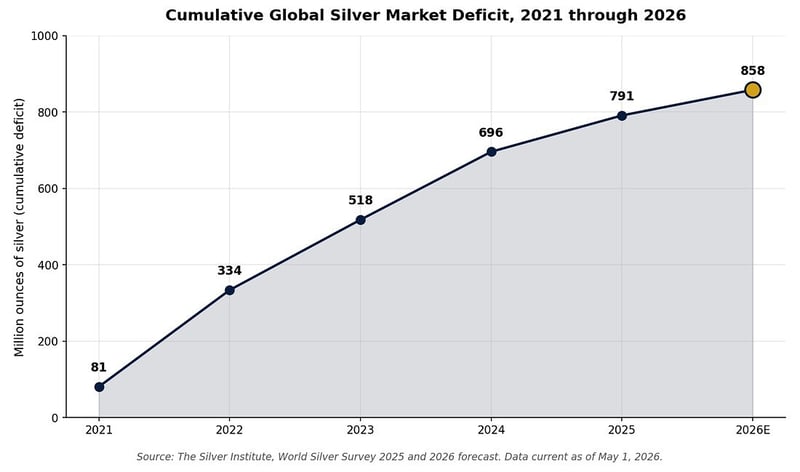
The Silver Institute is calling for a 67-million-ounce supply deficit in 2026, with some analysts putting the number well past 150 million ounces. The operating reality here is that no matter which figure you take, if it isn’t a surplus large enough to wipe out years of deficits, it’s still a supply scarcity signal.
Cumulative shortages since 2021 are already roughly 860 million ounces and growing.
Solar manufacturers remain the biggest industrial buyer of silver. Silver now represents 17-29% of the cost per watt of a photovoltaic module, up from around 10% in 2023. Meanwhile, EV production of 14-15 million units this year will consume about 12-15 million ounces.
Data centers, smart grid buildouts, and AI hardware needs are another large supply drag, and none of these industries or technology expansions are slowing down soon.
Why Supply Can’t Catch Up
Global mine production is projected at around 820 million ounces this year. Most of that silver comes up as a byproduct of copper, lead, and zinc mining. That means the new supply depends on whether copper and zinc producers want to expand.
As we detailed in our recent copper analysis, China announced on April 10 that it would halt sulfuric acid exports starting May 1. That restriction also tightens global silver supply, since most of the world’s silver comes up as a byproduct of the same copper, lead, and zinc operations that run on that acid.
Dedicated silver mines are rare, and many of the highest-grade deposits sit in remote, high-altitude terrain. Permitting, feasibility studies, construction, and ramp up periods can stretch close to a decade from discovery to first production.
This gap makes paper silver trading, the kind that moves off war and inflation headlines, a temporary substitute for real long-term value.
The gap is showing up right now in the flows. Since the Iran War began, the iShares Silver Trust (SLV) has been bleeding outflows while Sprott Physical Silver Trust (PSLV) and Aberdeen Physical Silver Shares (SIVR) have been pulling in capital. Investors are increasingly choosing funds with more direct physical backing over the paper proxies.
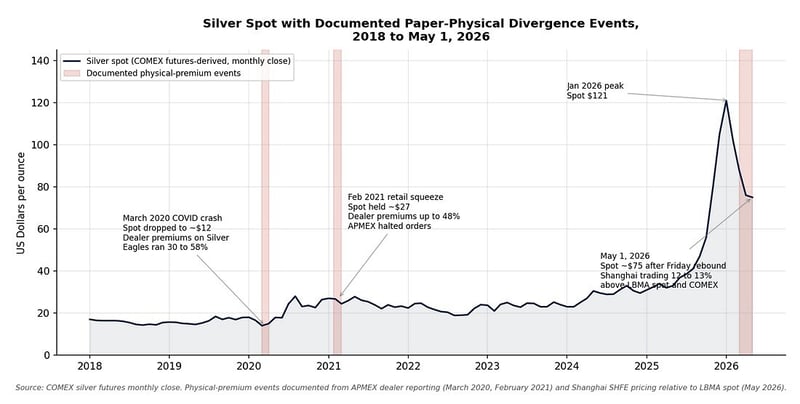
And there is a growing strain on the physical side, too. Registered silver on COMEX has dropped to 76 million ounces against 576 million ounces of open interest, which is coverage of 13.4%. That sits below the 15% level historically associated with delivery stress. Meanwhile Shanghai silver is now trading roughly 12-13% above LBMA spot and COMEX futures. The screen price has been falling through all of it.
We have seen this gap that exists now between paper trading and physical silver production before. In 1980, the Hunt Brothers ran silver from $6 to almost $50 an ounce on futures buying. The COMEX changed the margin rules and the price collapsed to $11 in a single day. The amount of physical silver in the world barely changed across that move.
The same divergence showed up in March 2020 when paper silver crashed to around $12 while premiums on physical American Silver Eagles ran 30% or more over spot. Then, in early 2021, retail traders tried to squeeze the silver market on the back of the GameStop run, coordinating through Reddit’s #SilverSqueeze movement and pushing spot silver above $30 in a single session.
The paper price barely moved after that for weeks, while every major bullion dealer ran out of inventory and APMEX halted orders on a wide list of products.
What that looks like in practice is very different.
And I can tell you that when you stand at one of these sites and look around, scarcity becomes visceral. When you’re roughly 2,000 meters beneath the earth’s surface, it becomes unquestionable. You can see the scarcity of hard assets as you drive into their sites.

Nomi Prins at the Zgounder open pit, Anti-Atlas Mountains, April 2026.
You can also see it in the single road that carries every ton of ore concentrate down the mountain, in the depth of the workings, and in the size of the ore body relative to the equipment and people around it.
Silver lies wherever geology put it, and the reality is that geology did not leave much of it in easy to access spots.
What This Means for Silver Investment
Physical silver keeps drawing from the safest haven locations as central banks and retail buyers shun paper alternatives that are demonstrably more volatile.
Producers with operating mines in stable jurisdictions are scarce. The management teams that actually run those mines well are scarcer still.
What all of this means is that six years of deficits have drawn down above ground inventories. China’s import numbers confirm what the inventory numbers already show. The world needs more silver than it has access to.
This is not a short-term trade driven by flashing headlines or fleeting market trends. What’s unfolding is a structural imbalance between physical supply and real demand – and it’s still building.
This analysis is not solely based on reports, I speak from physical experience! Only days ago, I went roughly 2,000 meters, or more than a mile, below the earth’s surface, Indiana Jones-style, to get to the bottom of silver scarcity and a budding supply jurisdiction. Not only does this process take time, but it requires highly-skilled professionals using increasingly complex methods to extract the metal and bring it to market as a refined product.
For Prinsights Pulse Premium and Founders+ readers, we will share a full report from that exact mine later this week with all the key details and everything you need to know. Our boots on the ground intel continues to give members not just an edge – but support for our model portfolios that are delivering real results.
Editor's Note: Omar Ayales is the Senior Trading Strategist & Editor at GCRU (Gold Charts R Us). If you have any questions, you can reach him at oayales@adenforecast.com or visit www.goldchartsrus.net.
The Inside Story
Don’t Lose the Signal in the Noise
By Omar Ayales
It’s easy to get pulled into the day-to-day movements of the market right now. Oil is moving sharply. Headlines out of the Middle East are constant. The U.S. dollar refuses to break down. Gold looks tired. And yet, if you take a step back, very little has actually changed.
The energy trade is real. The war in Iran continues to shape short-term price action in a meaningful way. Disruptions around the Strait of Hormuz, whether direct or implied, have reminded the market just how fragile global supply chains can be. Oil has responded accordingly, holding at elevated levels, and energy companies continue to be among the strongest performers.
But this is where it becomes important to separate what is happening now from what is likely to matter over time.
Markets, especially in periods like this, tend to overemphasize what is immediate and underweight what is structural. War, by its nature, creates urgency. It pulls capital into safety. It tightens liquidity. It forces decisions that might not otherwise be made. And in doing so, it can temporarily distort relationships that usually hold over longer periods.
The U.S. dollar is a good example of this.
On the surface, the dollar looks resilient. It has held above key support levels, even as other parts of the market have shown strain. But this strength is not coming from a place of long-term confidence. It is being driven by necessity. When oil rises, when uncertainty increases, and when global trade tightens, the demand for dollars tends to rise as well—not because the fundamentals are improving, but because the system still runs on it.
That distinction matters.
Because once the urgency fades, even slightly, the market tends to refocus on the underlying conditions. And those conditions have not improved. The U.S. continues to run large deficits. Debt continues to grow. Over time, that has always translated into a gradual erosion in the value of the currency—not in a straight line, but with long stretches where it becomes clear that strength was temporary, not structural.
This is where the relationship between the dollar, interest rates, and gold becomes particularly useful.
The next chart tells a story that is often misunderstood. The chart shows gold, the U.S. dollar index and the U.S. 10 year yield. There is a common assumption that higher interest rates are negative for gold. That is only partially true.
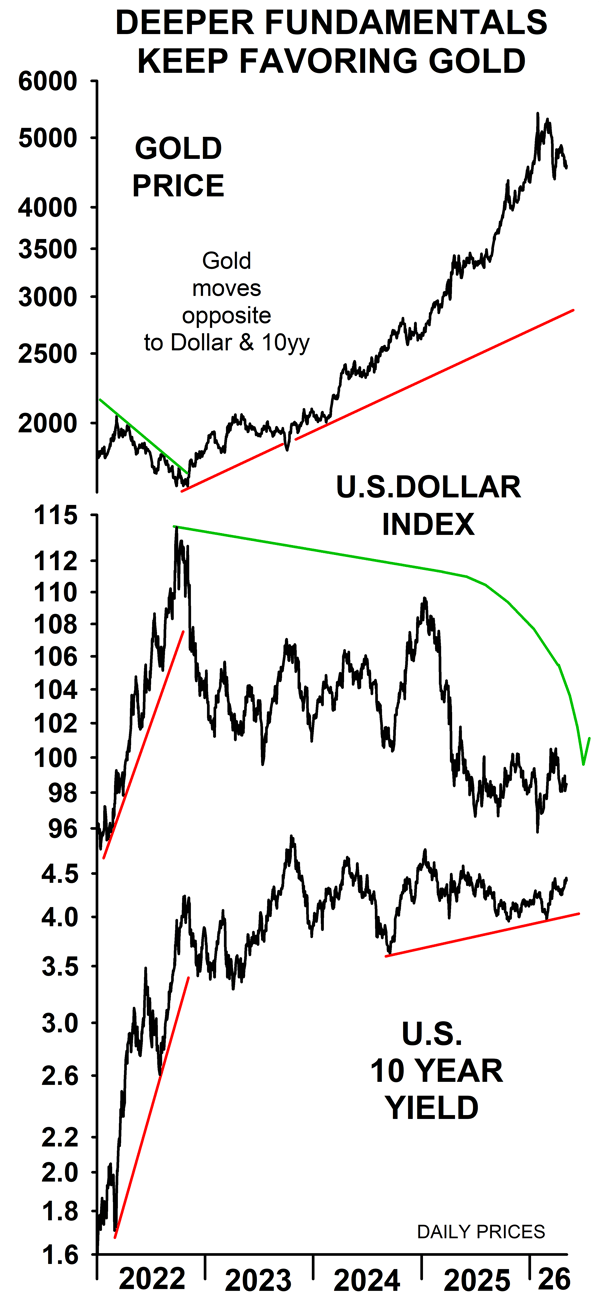
Gold tends to struggle when real rates rise. Not nominal rates—real rates.
In other words, what matters is not whether yields are going up, but why they are going up. If yields are rising because inflation expectations are increasing, then real rates can remain low, or even negative. In those environments, gold has historically done well.
And that is closer to what we are seeing today.
Oil is pushing inflation expectations higher. That, in turn, is pushing yields higher. But at the same time, the market is beginning to price in the possibility that central banks may need to stay tighter for longer in response. That expectation is what is keeping real rates from falling more meaningfully, and it is part of the reason gold has struggled to gain traction.
But this is a delicate balance.
If growth begins to slow, or if inflation stabilizes, that same dynamic can reverse quickly. Central banks move from holding rates higher to supporting growth. Real rates begin to fall. And gold tends to respond in those environments, often more quickly than expected.
So while gold may feel under pressure in the short term, the longer-term setup remains intact.
At the same time, something else has been happening, a little more quietly.
Copper has been holding up.
It hasn’t been immune to volatility, but relative to precious metals, it has shown strength. And that is not random. It reflects a shift that has been developing for some time now—a gradual rotation within the commodity space.
This isn’t about abandoning gold. It’s about recognizing that different parts of the cycle emphasize different assets.
Industrial metals are increasingly tied to real, physical demand. Infrastructure, electrification, energy systems, and supply chain logistics—these are not temporary themes. They are long-term requirements. And they require materials. Copper sits at the center of that.
At the same time, supply has not kept up. Years of underinvestment have left the market tight. So when demand expectations rise, even modestly, prices respond.
That’s why copper has been able to hold up, even in the face of broader market uncertainty.
But none of this diminishes the role of gold.
Gold operates on a different layer. It is not just another commodity. It reflects something deeper—confidence in currencies, in policy, in the system itself. And while it may lag at times, particularly when liquidity is tight and rates are elevated, it tends to regain relevance when those pressures begin to ease.
Which is why it continues to matter.
It’s easy to get caught up in the movement of the leaves—oil spikes, dollar strength, gold weakness. But the forest is still there, and it’s still moving in the same direction.
The dollar’s strength is conditional. Gold’s weakness is temporary. And the rotation within commodities continues, even if it doesn’t always move in a straight line.
The challenge, as always, is to see past what is immediate and stay grounded in what is enduring.
|