|
Perspective
By Rich Checkan
Last month I spoke about the “Incompetence Tax.”
To refresh, that’s the “tax” you pay in the form of higher prices because our Congressmen and Senators cannot balance a budget. Their fiscal irresponsibility leads to an expansion of the money supply, a diluted dollar, and higher prices for everything.
Well… we are all getting our “Incompetence Tax” bills this month.
Be sure to thank your elected officials.
Gold and Silver Have a Pulse
As I wrote to you last month, gold and silver were still consolidating right around $4,000 per ounce and $58 per ounce respectively.
Those of you hoping to pick gold off with an all-in price below $4,000 are most likely going to be disappointed. Gold surged in the past month to as high as $4,700, before pulling back below $4,400 per ounce earlier this week.
The shock that brought gold back to life came from Treasury Secretary Bessent.
As our fiscally incompetent leaders drove our national debt up through $40 trillion, Secretary Bessent panicked. He made two moves in short order that exposed his weak position.
First, he intervened on behalf of the Japanese yen.
To the casual observer, this looked merely as if a friendly nation was coming to Japan’s aid. After all, how could we stand by and watch an ally default?
The reality is that we were looking out for ourselves… not for Japan. If Japan was in danger of default, they would no doubt sell off the massive U.S. Treasuries they are holding in reserve. And if they did, that would cripple the I.O.U.S.A.
We simply could not let that happen.
The next move was even more transparent. With Treasury yields reaching their highest point since 2007, Secretary Bessent pledged to double the amount of Treasuries the U.S. Treasury was repurchasing.
In other words, since the world was demanding a higher and higher premium to take the increasingly bad U.S. debt, and since we could not afford to pay those higher interest rates on $40 trillion, the plan was to buy it back ourselves, with money we do not have, thus expanding the money supply even further… but temporarily avoiding a crisis.
Of course, all that does is kick the can down the road to a future point with an even larger monetary crisis.
Everyone saw this for what it was. Gold and silver prices sprang to life.
They did not take a pause until they were roughly 18% higher.
"To Every Thing There Is a Season…
… and a time to every purpose under the Heaven." (Ecclesiastes 3:1-8)
The time from fall through winter, for gold, is the time for higher prices.
Of course, there are no guarantees that this will be the case this year, but that is historically the pattern.
Jewelers are buying to make the trinkets consumers buy for wedding season, the traditional holiday season, and for new year’s celebrations.
Investors are back from vacation and once again paying attention to their investments… to include gold.
As a result, the high price for gold for any given year is typically hit between September and February. By typically, I mean 80% of the time.
So, even if Secretary Bessent did not shock gold and silver prices higher over the past month, they were bound to start their ascent anyway. He just got them moving a little sooner than usual.
If you do not own all the gold and silver you need at present, you should strongly consider buying now… unless you want to hold off for the more expensive stuff later.
Central Banks
At the risk of sounding like a broken record, I urge you once again to look at what the central banks are doing.
They have been buying gold like it is going out of style.
They have been buying gold at a pace not seen in the previous sixty years!
They have been buying nearly 1,000 metric tons of gold per year for half a decade.
They have been buying gold whether the price is high or low.
Why?
They know the trouble our fiat paper money experiment is in. They know the debt the world’s economy has taken on is unsustainable. They know this story ends with the house of cards collapsing.
They know, in the end, that whoever has the gold makes the rules.
We should follow their example.
You should follow their example.
Asset Strategies International was founded by Michael Checkan and Glen O. Kirsch in September of 1982. Never in our 44 years of business have we seen such a clear and obvious signal from central banks to buy gold to protect your assets… to preserve your purchasing power… to Keep What’s Yours!
What To Do…
1. Buy gold… now.
2. Buy silver… now.
3. If you need help to get started, call us toll free at (800) 831-0007, or simply email us.
4. Join us at 7PM EDT next Wednesday, September 9th. Adrian Day and I will be hosting Battle Bank’s Frank Trotter for our 5th On the Move webinar of 2026. Register Here!
5. Have a wonderful Labor Day holiday with family and friends. We will be celebrating Monday, September 7th, with our families and friends, but we will be back in the office to serve you on Tuesday, September 8th.
Happy Labor Day!
—Rich Checkan
Editor's Note: Frank Trotter, CEO of Battle Bank, has been involved in the banking business since 1981. He will also be the featured guest of our next On the Move Webinar on September 9th at 7 pm EST. Don't miss it! Register here.
Feature
What’s on the Other Side of Every Trade? A Serious Look at Currency Investing
By Frank Trotter
Every investor holds a currency position, whether they know it or not.
For example, an American who keeps everything in U.S.-dollar-denominated stocks, bonds and bank deposits has made a concentrated bet on a single piece of paper issued by a single government. For most of the past 15 years, that bet paid off handsomely and invisibly. In the early 2000's and over the past few years, it stopped paying.
The U.S. Dollar Index fell roughly 9.5% in 2025, its worst annual performance since 2017, and it posted the weakest first half since 1973. The euro gained about 13.1% against the dollar, the Swiss franc over 14% and the Norwegian krone over 13%. Investors who assumed currency was background noise discovered it was a very loud instrument.
This Battle Bulletin is about treating currencies as what they are: a distinct asset class with its own drivers, its own risks and its own role in a properly diversified portfolio. This is not a case for speculation or leverage. It is a case for understanding relative value among the world’s major monies and for refusing to let one government’s fiscal choices determine the fate of everything you own.
Of course, all investments carry risk of loss. The value of stocks, bonds, currencies and precious metals can decline. This bulletin is a backgrounder for your consideration, not a personalized recommendation. Discuss this with your financial advisor and always do your own research prior to making any investment.
Let’s Start With the Investable Universe
Not all currencies deserve consideration. Of the roughly 180 circulating currencies in the world, the serious investor should confine attention to the 20 or so largest. Within that group, your focus is best allocated to currencies that float with relatively little management. The currency’s price tells you something only if the price is allowed to move. The Chinese renminbi trades inside a band administered by the People’s Bank of China. The Hong Kong dollar is pegged. The Saudi riyal is pegged. The Danish krone shadows the euro by design. Whatever their other merits, these currencies are policy instruments, and holding them means trusting a bureaucracy to maintain an arrangement that history says bureaucracies eventually abandon, usually at the worst possible moment for the holder.
The relatively clean float among major currencies generally includes the U.S. dollar, the euro, the Japanese yen, the British pound, the Swiss franc, the Norwegian krone, the Swedish krona, and the Canadian, Australian and New Zealand dollars. Central banks in these countries intervene occasionally, and the Swiss National Bank has a well-documented history of leaning against franc strength. But on the whole, these prices are set by markets, which means they carry information and can be analyzed. That is the universe. Everything below the top 20 can be a liquidity trap, a capital control regime or a lottery ticket.
Currencies Are Not Equities
The next element we’ll look at is conceptual. Investors raised on stocks tend to import equity thinking into currencies, and it does not fully transfer. A stock is a claim on a (hopefully) growing stream of earnings. Over long horizons, a good business compounds. But a currency compounds nothing by itself. It is a relative price between two national monies, and for every currency that rises, another falls. Currency investing is a zero-sum exercise in relative behavior, plus whatever interest the deposit or instrument pays.
That distinction matters for expectations. In some years currency returns run parallel to equity returns. A U.S. investor holding Swiss francs in 2025 earned a currency gain in the same neighborhood as the Dow’s price gain, but the mechanism was entirely different. The Dow rose because 30 large businesses earned money and investors paid up for those earnings. The franc rose because global investors marked down the relative standing of the dollar.
The former is wealth creation. The latter is wealth measurement. Confusing the two leads investors to chase currencies the way they chase momentum stocks, and currencies do not generally reward that behavior. They tend to reward patience, valuation discipline and an accurate reading of relative fundamentals.
The volatility profile differs as well. Major pairs typically move with a fraction of the volatility of equity indexes, and the compensation for that lower volatility is lower expected return. Currencies in a portfolio are not there to make you rich. They are there to contribute to a diversified portfolio.
One Currency Is Not Diversification
Here’s the uncomfortable arithmetic for the typical investor. Own the S&P 500, a bond ladder, a money market fund and a house, and you may believe you’re diversified across hundreds of positions. But measured in currency terms, for the most part you own one position at 100% weight. Since nearly every asset you hold is priced in this currency, and your future liabilities are denominated in it, the concentration feels natural. But it is still concentration.
The argument to ignore currencies writes itself when the dollar is strong, as it was for most of 2011 through 2024. During those years, unhedged foreign exposure was a drag, and dollar concentration looked like wisdom.
But then 2025 arrived with a new administration and new policies, and the same concentration subtracted double digits of global purchasing power in 12 months. Morningstar noted that through September 2025, the dollar had depreciated 13.1% against the euro and about 14% against the franc. An American with no foreign currency exposure did not avoid the currency market that year. They simply took the losing side of it, in size, without ever placing the trade consciously.
What Actually Drives Relative Currency Values
Currency prediction has a deserved reputation for difficulty over short horizons. Over multiyear horizons, relative valuations generally respond to identifiable forces, and the investor’s job is to weigh them together rather than fixate on any one factor. And yes, I’ll use the word “relative” often since that’s the key element.
Relative inflation. Purchasing power parity is a poor timing tool and a good anchor. Persistent inflation differentials eventually pull exchange rates toward lower inflation. A currency whose domestic purchasing power erodes at 4% annually while another erodes at 1% fights a three-percentage-point headwind every year until the differential closes.
The relative fiscal situation. Deficits matter as a percentage of GDP, and they matter more when they’re structural rather than cyclical. A government borrowing 6% to 7% of GDP at full employment, as the United States has been doing and is forecast to do, is signaling that the gap will be closed by growth it cannot manufacture, austerity it will not choose or monetary accommodation it will eventually demand. Markets price that third possibility into the currency. Much of the dollar’s 2025 slide traces to exactly this reassessment of American fiscal credibility.
The relative national debt position. Flow is the deficit; stock is the debt. Gross debt above 100% of GDP does not doom a currency immediately, as Japan long demonstrated, but it removes room for error and raises the temptation toward financial repression, where rates are held below inflation to erode the debt quietly at the expense of anyone holding the currency. Countries with low debt ratios retain policy freedom, and policy freedom is what a currency holder is ultimately buying.
The global view of risk and credit standing. Currencies carry reputations. The franc and yen have historically attracted crisis capital; the dollar did, too, until recently. That reputation is now shifting under the dollar’s feet. In early 2026, Deutsche Bank’s head of FX research went so far as to call the dollar’s safe-haven status a myth, observing that the dollar has decorrelated from equity sell-offs. The freezing of Russian central bank reserves in 2022 taught every reserve manager on earth that access to dollar assets is conditional on political alignment, and the resulting migration into gold and alternative reserves is a slow-moving repricing of American credit standing with years left to run.
Total float and share of global economic activity. Liquidity is a value in itself. The dollar and euro dominate global payments and reserves, which grants them a durability premium and their holders an exit door in any crisis. Smaller floats like the krone swing more widely precisely because the pool is shallow. One possible strategy is to hold the deep currencies for stability and the shallow, well-governed ones for value and size positions accordingly.
Interest rate differentials. In the short run, this is often the dominant driver. Capital flows toward yield, and a currency where local rates are relatively higher, combined with sober fiscal and other financial management, tends to appreciate against a currency backed by a low-rate environment. Following the Federal Reserve’s 2025 cuts, Norway emerged as the highest-yielding G10 currency, a fact State Street cited in maintaining its positive stance on the krone. But rate differentials are the weather, while the fundamentals above are the climate. Chasing carry into a deteriorating currency is how investors get paid in pennies and charged in dollars.
Where We Have Felt Confident: Commodity Producers and Fiscal Adults
Applying the above filters over the years has repeatedly led us to the same short list: currencies of countries that produce real things the world must buy and countries that run their public finances like adults. Sometimes the same country checks both boxes.
The Norwegian krone. Norway is the developed world’s cleanest expression of fiscal responsibility paired with good fortune in terms of natural resources. Its sovereign wealth fund, built from oil and gas revenue, exceeds $1.7 trillion for a nation of 5.5 million people. The state is, in net terms, a creditor of historic proportions. The krone spent much of the past decade undervalued and out of favor, then gained about 13% against the dollar in 2025 as energy revenues, top-of-class G10 yields and the dollar’s troubles converged. A shallow float means volatility, but the underlying balance sheet is the strongest in the developed world.
The Australian dollar. Australia exports iron ore, natural gas, coal, gold and food into Asia’s growth, and its public debt ratio remains modest by G7 standards. The Aussie is a classic commodity currency, rising with global risk appetite and resource demand. It lagged the European currencies in 2025, gaining mid-single digits, then extended toward the 0.70 to 0.71 range in early 2026 as the Reserve Bank of Australia held a firmer line than the Fed and commodity prices stayed elevated.
The euro against the U.S. dollar. The euro is nobody’s idea of a perfect currency, and skeptics like Doug Casey dismiss it outright as a committee construction of bankrupt welfare states. But currency investing is relative, and the relevant question is not whether the euro is sound in the abstract but whether the eurozone’s aggregate fiscal position, external balance and monetary conduct compare favorably with America’s right now. On deficits, the comparison currently favors Europe. The euro’s 13.1% gain in 2025, carrying it to an all-time high in trade-weighted terms, reflected that relative judgment, along with the sheer depth of euro markets as the only alternative parking lot for reserve-scale capital.
The Swiss franc. Switzerland pairs perpetual current account surpluses with low public debt, low inflation and an institutional culture that treats debasement as a moral failing. The franc gained over 14% against the dollar in 2025, extending a century-long record of relative appreciation. Counter to the interest rate differential argument, the cost of that virtue is near-zero yield and a central bank that periodically resists further strength. What the franc pays is preservation, and over long stretches, preservation against the dollar has been worth several percent a year all by itself.
A Word About the Kiwi
New Zealand’s dollar is routinely comingled with the commodity currency bloc, filed alongside the Aussie and the loonie as if the three were interchangeable. The grouping is correct as far as it goes but misleading past that point. The kiwi is genuinely commodity linked: Dairy, meat and horticulture dominate exports, dairy auction prices move the currency, and China’s appetite sets the tone as New Zealand’s largest trading partner. But the kiwi’s commodities are soft, not hard. New Zealand sells protein and produce, not energy and metals, so it participates only partially in the hard-asset cycles that drive the loonie and the Aussie. Add a chronically deficit-prone current account, a small and shallow float, and a central bank with a history of aggressive swings, and the kiwi becomes the most fragile member of the family.
The year 2025 demonstrated the distinction. While the Aussie gained against a falling dollar, the kiwi actually lost ground, sinking a bit as the Reserve Bank of New Zealand slashed its cash rate to 2.25% in response to a shrinking economy, a second-quarter GDP contraction of 0.9% and unemployment at a five-year high. Two commodity currencies, one dollar bear market, opposite outcomes. The lesson is that the commodity label is a necessary screen, not a sufficient one. The fiscal, monetary and external filters still have to be applied, and on those filters New Zealand currently fails where Australia passes.
Gold: The Currency Without a Central Bank
No serious discussion of currencies can end with paper. Gold is the one money in the system that no committee can print, and its price is best understood not as a commodity quote but as the inverse of confidence in the entire fiat complex. With that reading, the recent message is unambiguous. Gold surged roughly 65% in 2025, its largest annual gain in over four decades, and by mid-2026 it traded above $4,100 per ounce. Central banks, the same reserve managers that absorbed the 2022 lesson about the political conditionality of dollar assets, bought at elevated rates for a third consecutive year.
What the Commentators Are Saying
The independent financial analyst world saw all this earlier than Wall Street did, which is worth acknowledging even while discounting the theatrics. Chuck Butler deserves first mention because he’s been making the currency diversification case longer than almost anyone in American finance. His Daily Pfennig letter, still publishing today, has hammered a single theme since at least 2005: Deficits do matter, and never in history has one country owed so much to the rest of the world without a currency crisis.
Jeff Opdyke, the former Wall Street Journal writer now publishing from Portugal, has argued for years that Americans should hold foreign accounts and currencies. He warned of the dollar’s diminution as BRICS nations assemble alternatives and claims vindication in the 2025 decline.
Doug Casey remains the maximalist: To him, every fiat currency is an IOU nothing — the dollar most dangerously so given its numeraire status. His prescription is to exit into precious metals rather than rotate among papers.
Grant Williams offers the historically grounded frame, tracing an 80-year arc from Bretton Woods and arguing that reserve currencies fade through redirection rather than collapse, with the 2022 reserve freeze as the Suez moment that taught central banks the dollar carries political risk.
Alexander Green and the Oxford Club strategists occupy the moderate wing, advocating global diversification across asset classes within conventional portfolios rather than using it as an escape from them.
And the mainstream has now converged partway toward all of these views. J.P. Morgan’s private bank tells clients the dollar’s risks skew downward and recommends revisiting currency allocations. Morningstar calls the dollar still overvalued despite the 2025 decline and points to non-U.S. assets for value and currency appreciation potential. Morgan Stanley has floated another 10% of dollar downside by the end of 2026. When the contrarians and the wire houses agree on direction and argue only about magnitude, the sensible conclusion is not panic. It is allocation.
The Opportunity
Currency investing done properly, like a lot of our daily chores, is unexciting. Confine yourself to the major floating currencies. Expect currency-like returns, not equity-like returns, and understand that in the occasional year the two will rhyme. Judge currencies on relative money growth, relative inflation, relative deficits and debt, credit standing, float and rate differentials — weighed together — and apply those filters even inside the commodity bloc, where the kiwi and the loonie show that geology alone is not enough. Favor the monies of commodity producers and fiscal adults: the krone, the Aussie, the franc and the euro as the liquid counterweight to the dollar. Keep gold as the anchor beneath the whole structure, the one currency that answers to no finance ministry. And above all, stop mistaking a 100% dollar portfolio for a neutral position. There is no neutral position. There is only the currency risk you chose and the currency risk you never noticed you were taking.
Learn more about buying and selling currencies at Battle Bank.
FDIC-insured deposits denominated in foreign currency are not insured against market loss due to a decline in the value of a particular foreign currency; if the price of a currency falls and you sell a loss of principal will occur.
Battle Bank has marketing relationships with various publishing companies that include financial renumeration. At times in our articles there will be quotes from editorial content published by these organizations.
Editor's Note: Bill Bonner is the Founder of Bonner Private Research and owner of the Agora Companies. This article was originally published by Bonner Private Research on August 31, 2026. You can subscribe to Bonner Private Research here (save 62% on an annual subscription with this link).
Hard Stuff
All Bubbles End in Deflation
By Bill Bonner
When the feds are going to print money, the dollar becomes a hot potato. They aim to get rid of it as soon as possible. Sales go up in the short run. In the longer run, the economy is destroyed.
We begin this week’s perambulations with a stroll into the future.
So far...the Bubble in the US is broader than any in history. It has been inflating everything it touched for the last 30 years.
All bubbles pop, of course. How they pop is the confusing whirlwind we enter today.
But don’t worry. Even in the worst crash, real wealth doesn’t disappear, it just changes hands. When the stock market goes down, those with stocks have less paper wealth...and less of a claim on real wealth. They are ‘poorer.’ That leaves those without stocks relatively richer. They have a bigger claim on the real goods and services the economy produces.
The feds and their elite cronies have a good racket going...diddling markets so as to shift more and more wealth away from the public and towards themselves. They own most of the capital assets...and they control the US budget. Pressuring interest rates lower, and backing up the stock market with bailouts and ‘put’ options...they’ve gotten richer and richer. As we saw last week, at today’s prices the stockholding class can theoretically buy twice the GDP...and have $10 trillion left over.
It wasn’t capitalism that made them so rich; it was a corrupt money system. And if the dogs of capitalism were unleashed, they’d have their fake money fortunes for dinner. Interest rates would be set by honest savers and borrowers — not by Fed policy decisions. Prices would be determined by buyers and sellers; the budget would be balanced; the debt would be cleaned up; the troops would come home; inflation would disappear; and the Baltimore O’s would win the World Series.
But of course, we’re dreaming.
Sticking to the real world...
Our high confidence guess is that the bubble will deflate. Everything will fall in price. Then, the feds will panic. They will do ‘whatever it takes’ to stop markets from doing their work — with more fake money, lower interest rates, yield curve control, quantitative easing. And probably some tricks we haven’t heard of yet.
After an initial sell-off, gold will go up. It will sniff out what is coming — more inflation. Other real asset prices too — from hot dogs to hotels — will get a whiff of the coming price hikes. Consumer prices will rise as ‘inflation expectations’ increase.
The feds really only have one tool — fake money. In a crisis, they will produce more of it...a lot more. And, in addition to the quantity of money coming into the economy, there’s another key inflation variable: the velocity of money. A dollar spent two times in a year is counted twice.
When people think the feds are going to print money, the dollar becomes a hot potato. They aim to get rid of it as soon as possible. Sales go up in the short run. In the longer run, the economy is destroyed.
And here’s an important addendum. We say ‘inflate or die.’ But those are just policy choices. In the long run, you can inflate all you want. The bubble will still die — a later, more gruesome death.
In the fight between markets on one side...and politicians, grifters, fixers and central planners on the other...markets always win, eventually. They win by deflation.
Even in an inflationary blow off — with prices soaring — real prices fall. Consumer prices rise, in nominal currency. But gold — real money — typically rises even more...so that in gold terms, real things actually become cheaper. Prices deflate in real terms.
Observers in Germany’s record-setting hyperinflation remarked that foreigners were able to use dollars — then, backed by gold — to buy things at absurdly low prices. By November, 1923, a dollar was equal to 4.2 trillion marks. This made American visitors trillionaires (in marks) allowing them to buy whole houses for the price of a magazine subscription. In real terms, prices had deflated down to almost nothing.
We witnessed it, ourselves, in Argentina. In pesos, consumer prices more than doubled every twelve months...but dollars (even with a dodgy dollar) made them cheaper than ever. We would go to a restaurant, for example, and feel guilty about paying so little for such a good meal.
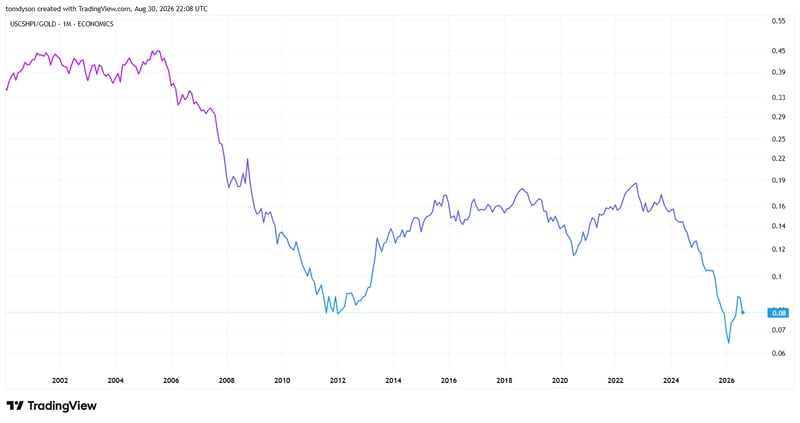
The same phenomenon is already taking place in America, too. Housing has gotten much more expensive, right? And the stock market is much higher too, right? But looked at in terms of gold, stocks are less than half of what they were worth in 1999...and the Case-Shiller Home Price Index, expressed in gold, shows house prices down about 80% over the last quarter century.
In real terms, all bubbles deflate...but you need real money to see it.
Editor's Note: Porter Stansberry, Founder and Chairman of Meadowdale Holdings, has been rewriting the rules of financial publishing for over 25 years. This article was originally published in Porter Stansberry's Daily Journal on August 19, 2026. To subscribe to this free daily newsletter, click here: https://join.portersdailyjournal.com/
The Inside Story
Follow The Flow Of Money
By Porter Stansberry
ThexxxHow do I know the funding and the buildout won’t continue? Because this entire bubble was never about technology. The bubble around the artificial intelligence (“AI”) buildout was caused, like all financial bubbles, by a corruption of the money supply.
The railroad boom of 1865-1873 was fueled by the paper money of the Civil War. The telecom bubble of 2000 was fueled by the Federal Reserve’s response to the Russian default and fears about Y2K. And, of course, the mortgage bubble of 2008 was fueled by the Fed’s aggressive response to 9/11 and the “War on Terror.”
The AI bubble is a direct result of the Federal Reserve’s response to COVID. Our central bank created an unimaginable amount of new money – roughly $7 trillion.
By late 2021, the money market funds that received most of this cash couldn’t find enough safe, short-term places to put it. So the Fed opened up what amounts to a giant parking lot for cash. It’s called the reverse repo facility (“RRP”).
Don’t let the jargon fool you. This is simply the government printing money and handing it out to favored financial institutions.
Technically, it works by a money market fund depositing its cash to the Fed overnight. (Note: there’s no reason the Fed, which can create as much cash as it wants, would ever need to borrow money from a money market fund.) The Fed then gives the fund a Treasury security as collateral for the night. The next morning the Fed gives the cash back plus a tiny amount of interest. It’s called “reverse repo” because from the Fed’s point of view it’s the reverse of a normal repo – the Fed is borrowing the cash rather than lending it. Once again – as with neocloud, which I wrote about on Monday – when something is called a made-up word that has no actual meaning in the English language, beware.
With the Fed handing out money for nothing, it was no surprise that the RRP “parking lot” filled up fast. At its peak in December 2022, the RRP held about $2.5 trillion in money market fund cash.
And that money is what has been powering the entire AI bubble.
Let me show you what happened.
Early in 2023, the interest rate on Treasury bills rose above the rate the Fed was paying on RRP cash. That happened because the Fed was responding, finally, to the massive inflation their policies and the government’s massive deficits had caused.
Money market funds are legally required to seek the best safe yield they can, so as interest rates rose, they pulled cash out of the RRP and bought T-bills instead. This happened continuously from mid-2023 through October 2025. Roughly $3 trillion of cash came out of the RRP over that period – from $2.5 trillion at peak down to essentially zero by October 2025.
As you’ll see below, what happened to this capital as it entered the private financial system is complicated. But all you have to know is that from mid-2023 until last October, trillions in capital flooded into our financial system. And that’s what’s driven equity valuations higher and higher, and that’s what’s funded the entire AI buildout.
The key thing to know is this: that money is now all spent.
Our private financial system works primarily on two tiers. Money market funds (when they can’t get a completely free ride from the Fed) lend cash to primary dealers (the biggest banks). The primary dealers relend cash to everybody else: hedge funds, private credit funds, real estate financing vehicles, and increasingly, the AI-capex financing engine.
When the RRP started draining in 2023, the money that came out went into T-bills at first. But it didn’t stay there. Through private repo lending, it funded the primary dealers (the big banks). And because the big banks now had an enormous amount of cheap short-term cash coming in, they lent out more and more to non-bank borrowers. Why? Because trillions in capital had to land somewhere in only about two years.
Non-bank is finance jargon for any lender or credit institution that isn’t a chartered bank. It includes hedge funds, private credit funds, private equity firms, mortgage lenders that aren’t banks, insurance companies, pension funds, real estate investment trusts, business development companies, structured product vehicles, and so on.
Collectively, they are called the “shadow banking system” because they perform banking functions – they extend credit – but they don’t take insured deposits and don’t have direct access to the Federal Reserve’s liquidity facilities.
The shadow banking system has grown enormously over the last 15 years. It’s where most private credit lending lives – Blue Owl Capital (OWL), Apollo Global Management (APO), Ares Management (ARES), Blackstone (BX), and KKR (KKR). It’s also where most of the AI-capex financing sits. Not the equity – that’s on the hyperscalers’ balance sheets – but the debt behind the data centers, purchases of the high-speed GPU chips, and neocloud operators. That financing gets warehoused in the shadow banking system and eventually distributed as securitized paper, which, hey, why not, Moody’s says it’s AAA!
The shadow banking system funds itself largely through repo. It borrows short-term cash from the primary dealers, secured by whatever collateral it holds – Treasuries for the most part, but also mortgage bonds, corporate loans, structured products rated AAA. That’s what’s so valuable about that Moody’s rating.
As a result, from mid-2023 through October 2025, both sides of the plumbing grew at the same time.
The primary dealers’ repo funding grew because money market funds pushed more and more cash into it as they pulled out of the RRP. Non-bank lending grew because the primary dealers, flush with all that new cheap cash, extended it out to the shadow banking system, which used it to fund private credit, hedge fund leverage, and – most importantly for our purposes – the entire ecosystem of data center loans, GPU-backed term loans, and neocloud financings.
Both grew because the same exogenous force – the RRP draining – was pushing money into both simultaneously. It looked like the private credit system was generating its own growth out of business demand. It wasn’t. It was being lifted from underneath by the parking lot emptying.
By October 2025, the RRP was effectively empty. The parking lot was drained. The COVID “credit card” was tapped out.
From that point on, the financial system became zero-sum. Any new dollar of primary-dealer repo funding has to come from somewhere else in the system. It can’t come from the RRP anymore because the RRP is empty.
Money market funds have a finite amount of cash to lend. If they lend more of it to primary dealers in repo, they have less to lend elsewhere. And the primary dealers, if they want to keep their own repo books growing, have to pay higher interest rates to attract that cash. Higher repo rates raise the shadow banking system’s funding cost. Higher funding costs mean the shadow banking system can either extend less credit or charge borrowers more.
The mechanical result: if primary dealer repo grows, non-bank lending shrinks by approximately the same amount. The two lines that had been rising together for three years – bank repo and non-bank credit – now move inversely.
That’s what’s happening. The correlation flipped in October 2025 and has stayed flipped. Repo went from a rising tide that lifted both dealer and shadow-bank balance sheets to a zero-sum competition between them.
Nvidia (NVDA) saw this coming and raised $25 billion to survive what’s about to happen. CoreWeave’s (CRWV) most recent financing tanked because of the impact of a zero-sum financial world.
Shadow banking is being squeezed. The most-leveraged, weakest-collateral, most-concentrated shadow bank borrower – a neocloud with GPU collateral serving AI customers – gets repriced first.
But this is only the beginning.
The two-year Treasury to Fed Funds interest rate spread sits at +50 basis points – the same level reached in the second halves of 2001, 2008, and 2021. Emerging-market inflows just posted one of the largest sudden stops on record. Real U.S. personal income is falling at recession pace. Year-to-date household-survey employment losses exceed both 2001 and 2008. Prime-age labor-force dropouts are at ex-COVID records. Except for mortgages, credit delinquency rates are at crisis highs.
What ends a capex boom? It eventually runs out of money.
Jesse Livermore described what happens when a capex boom runs out of money in Edward Lefevre’s book Reminiscences Of A Stock Operator.
"Finally there came the awful day of reckoning for the bulls and the optimists and the wishful thinkers and those vast hordes that, dreading the pain of small loss at the beginning, were now about to suffer total amputation – without anesthetics. A day I shall never forget, October 24, 1907… No money anywhere, and you can’t liquidate stocks because there is nobody to buy them. The whole Street is broke at this very moment."
Livermore made $1 million on that day. He saw his signal to start shorting when the railroads began advertising equity offerings that had earlier and earlier execution dates and accepted payment in installments.
He recognized a death struggle for capital.
Will you?
|