|
Perspective
By Rich Checkan
From Michael, me, and the entire Asset Strategies International Team, best wishes to you and yours for a Happy, Healthy, and Prosperous New Year!
Precious metals were THE story in 2025. But what can we expect for an encore in 2026?
More of the same.
In this issue of Information Line last year, I encouraged you not to take a “wait and see” attitude toward precious metals until after some of President Trump’s policies took hold. Rather, I suggested you buy gold and silver on every dip.
I finished that forecast article off with a simple call to action… “Embrace this dip!”
Congratulations to those who listened and took action. You were rewarded with all-time highs for gold, silver, and platinum. And you saw the highest one-year appreciation in gold and silver since 1979… three years before ASI was founded.
Here are the numbers for 2025…
|
|
31 Dec 2024
|
31 Dec 2025
|
Change
|
|
DJIA
|
42,544.22
|
48,063.29
|
+ 13.0%
|
|
S&P 500
|
5,881.63
|
6,845.50
|
+ 16.4%
|
|
NASDAQ
|
19,310.79
|
23,241.99
|
+ 20.4%
|
|
Oil
|
71.72
|
57.90
|
(-) 19.3%
|
|
EUR
|
1.0406
|
1.1739
|
+ 12.8%
|
|
CHF
|
1.1071
|
1.2618
|
+ 14.0%
|
|
GBP
|
1.2549
|
1.3455
|
+ 7.2%
|
|
JPY
|
0.0064
|
0.0064
|
UNCHANGED
|
|
Gold
|
2,625.60
|
4,339.65
|
+ 65.3%
|
|
Silver
|
28.96
|
75.24
|
+ 159.8%
|
|
Platinum
|
915.00
|
2,044.70
|
+ 123.5%
|
|
Palladium
|
934.00
|
1,649.90
|
+ 76.6%
|
|
Bitcoin
|
93,429.20
|
87,612.70
|
(-) 6.2%
|
For those of you who did not or could not buy last year, it should both comfort you and surprise you to know that you are not too late. The ship has not sailed. You can still climb aboard.
Personally, I still see the potential for thousands of dollars of appreciation still in gold, and potentially another hundred dollars appreciation in silver.
The future is still very bright for platinum and palladium as well, but I tend to focus on monetary metals because I see many of our problems rooted in fiscal irresponsibility.
Higher? Really?
Absolutely… yes.
For starters, do you see a consensus in Congress to balance the budget, cut spending, and pay down the debt?
Without those three things, our money supply will need further expansion to pay for our financial obligations. And monetary expansion always leads to producer and consumer price increases.
Then, consider how many fundamental indicators of the end of the precious metals bull market are suggesting we are at the top. Correct… none at all.
I will not go into each one in detail here. I have done so on multiple occasions recently, but here is the list…
- Duration of the bull market
- Gold price
- Gold / Silver Ratio (GSR)
- Dow / Gold Ratio (DGR)
- U.S. dollar strength (or weakness)
- Interest rates
- Geopolitical stability
- Social stability
- Sentiment
Not a single one of these indicators have hit the point where they suggest an end to this bull market.
Further, we need to start to see three or four of them flashing “top” before we need to start looking for the exits on this precious metals bull market.
In my estimate, there is still plenty of time.
Proceed Cautiously
All that being said, I do think it is time to be wary of the activity in the market and to exercise caution.
I am not saying to sit on the sidelines and watch. Rather, it is time to review your goals and objectives and to make sure your plan for owning precious metals is consistent with them.
This is less of a concern for gold holdings.
Gold holdings are your wealth insurance. They are a store of purchasing power, with high liquidity, for a potential financial crisis you hope to never have.
Unless you have a financial emergency, selling, at any price, is not an option in my book. But you should be looking at every dip as a means to acquire more if you do not yet have your desired allocation in gold.
Silver, platinum, and palladium are different to me. They all tend to be good vehicles for those of you buying precious metals with a profit motive. They tend to be a bit more volatile, are influenced by industrial supply and demand factors, and they have a greater potential for profit… and loss as well.
As a result, I manage my silver, platinum, and palladium holdings. In fact, I just sold some silver… even though I fully expect higher silver prices.
You see, if you take profits on surges upward in prices and buy well on dips downward in prices, you maximize your profit potential all throughout the bull market. Therefore, you never have to worry about missing the top.
Unless… the dip is not a dip. When the dip is the start of the bear market, you no longer buy. You switch to sell mode.
That is where the nine indicators come in that I mentioned earlier. They are what help you identify the bear market is taking hold.
Again, at this time, no indicators suggest and end to the bull. So, I took some profits in silver, and I will be looking for a short-term dip to buy back in well.
Given silver’s move this past year, it was an easy decision. When you can take your initial investment off the table, and still have more invested than you initially invested, it is hard to lose on that investment. In fact, it is impossible.
Take Action
Do not let fear keep you from doing what you know you should be doing.
The Federal Reserve has started Quantitative Easing (QE) once again. Money is cheap and getting cheaper.
BUT… we all know that comes with a cost.
Over time, everything you buy with U.S. dollars will be more expensive. The dollar will be “worth-less.” There is no other potential outcome from monetary expansion.
As weak as they are, convert a portion of your U.S. dollars to gold and silver… gold for insurance and silver for profit. As the dollar weakens further, gold and silver will be your saving grace.
Act with your investment assets. Act with your retirement assets.
Act now if you want to Keep What’s Yours!
Send us an email. Call us toll free at (800) 831-0007.
We stand ready to help.
—Rich Checkan
Editor's Note: Peter Boockvar is Chief Investment Officer of One Point BFG Wealth Partners. In his role as CIO, Peter leads the team that is responsible for the development, management and oversight of One Point’s investment management program, managing the investment committee, and setting the firm’s overall investment philosophy, global investment outlook and asset allocation decisions. He is also the portfolio manager of two internal portfolio strategies. Peter is also a CNBC contributor and Editor of The Boock Report on Substack. He will be joining Rich Checkan and Adrian Day for a free webinar on January 14th at 7 pm. Click here to register.
Feature
Market Commentary
By Peter Boockvar
If one went to sleep on November 1st and woke up on November 28th, the last trading day of the month, it would seem that nothing was missing and boring was the best way to describe stock market performance as the S&P 500 was about flat, up by 0.1%. For those of us who were awake and lived each trading day, it was quite a wild ride instead. Intra month the index traded down by as much as 4.6% from the October close to the intraday low on November 24th, breaking below the 50-day moving average and testing the 100-day moving average. A vibrant five-day rally into the end of November saved the month. The NASDAQ fell 1.5% and was the main drag as something important I believe started to take place. The spectacular GenAI tech trade which started in earnest in early 2023 that brought so many stocks with it that touched this growing ecosystem, began to splinter where investors began the process of picking who will win and differentiated from those that might not.
The main catalyst for the late month rally was the speech given by NY Fed president John Williams, a voter at every meeting. He said he favors another rate cut in the ‘near term’ which seems like code words for the December 10th meeting. The rate cut odds prior to his speech were about 32%. They immediately spiked after he spoke and as of this writing, they are at 78%. We’ve clearly learned that Wall Street loves easier money and even long-term rates fell too. Whether long rates will continue to drop I’m skeptical because on the flip side, long term interest rates have been rising around the world, particularly in Japan where the Bank of Japan is expected to increase rates on December 19th. And, while the Fed has cut interest rates, before the December move, by 150 basis points beginning in September 2024, the 10-yr yield is barely down from that summer.
I’m sure you’ve heard the question of whether we are in an AI bubble or not, but that’s way too vague, that needs important context and conciseness. The question should instead be, are we in a GenAI CapEx bubble as AI has been evolving for many decades and will continue to do so in the decades to come. To dig deeper, while the demand for computing power is growing tremendously, investors are beginning to ask the tough questions on whether companies building the physical infrastructure of this data center buildout are overspending on an unproven model in monetizing it. For context, the large hyperscalers have increased the rate of their CapEx to about 50-75% of EBITDA and relative to revenue, CapEx has gone up 2x-5x depending on the company from where it stood before 2022. And more of this spending now is being debt financed. For those students of market history, we know the winners that came out of the internet buildout in the late 1990’s were not the infrastructure builders but those companies that layered their business on top of it, aka, the users of the internet.
In the late 1990’s, Cisco Systems was considered the backbone of the internet, and its stock was well rewarded up until 2000 when it crashed, along with everything else. What came back the quickest though, were those businesses built using the pipes of the internet, such as Amazon. Many so-called ‘picks and shovels’ companies like fiber optic builders, networking equipment, etc. needed to build the infrastructure of the internet, never made it out. As for Cisco’s stock, Twenty-five years later, it still remains below its March 2000 peak. Whether history is repeated or not, we’ll of course have to see, but maybe at least for now we are transitioning the GenAI tech trade to market differentiation between the perceived winners and losers. And then we’ll get to see who is best at integrating it into their businesses and households.
Also, something to think about is the growing competition coming from Chinese tech companies who are building out their own large language models (LLM) with the growing compute help from their own semiconductor chips and infrastructure. While most of the US LLM models are close sourced, China is going down the path of open source which means they are essentially giving them away for free. In terms of getting customers around the world for these models, China is going to be an intense, price competitive challenger.
I bring this all up because it is important to understand how reliant the US economy and the US stock market have become on both the AI tech trade and the data center buildout. Within the S&P 500, the top 8 stocks make up almost 40% of the index, extraordinarily concentrated - all with heavy exposure to GenAI’s ecosystem. With regards to the economic impact of the infrastructure buildout of GenAI, I have seen estimates that it made up about 50% of the first half GDP growth of 1.6%. Thus, without this CapEx, GDP growth would have been less than 1% on an annualized basis over the first two quarters of 2025.
November also saw the end of the government shutdown, which wasn’t really a market concern anyway as we all knew it was eventually going to reopen. It was though, a pain for travelers, those government workers who saw delays in getting paid and contractors to the government that had work disrupted. As taxpayers, I think it’s safe to say that we all pay for a government that should not close. Anyway, the GDP implications of the shutdown are negligible though in the context of a $30 trillion economy.
International stocks in November took a breather too but the year-to-date gains are still very impressive after years of underperformance relative to the US S&P 500. With the help of a weaker US dollar, here are some of the year-to-date index performance numbers as of this writing. For a US based investor, the Spanish IBEX is up 59%, the Italian MIB higher by 42%, the German DAX has rallied 33%, the Hang Seng is up 29%, the Japanese Nikkei higher by 25% and the South Korean Kospi is up a whopping 65% helped by large gains in Samsung and SK Hynix.
I highlight this to show that in 2025 investors widened their lens of investing opportunities with regards to not just geography, but even to small and medium size stocks that have done well, along with parts of the value parts of the market. Other asset classes too have had a good year, such as precious metals. I expect these trends to continue past 2025.
There really hasn’t been much change in global economic trends. The US economy still remains very mixed and uneven. The big positive, as stated above, is of course the data center buildout but the economy is also getting a lot of help from upper income consumers who are benefiting from owning stocks and their home. On the other hand, manufacturing and housing are in a recession while lower to middle income consumer spending remains muted especially for those that don’t own stocks and are renting their homes. With respect to the labor market, the pace of firing remains muted, but the rate of hiring has clearly slowed as seen in a variety of metrics.
Globally too, the economy is mixed and uneven. Within Europe, Germany and France, we are seeing sluggish activity but Spain, Greece and Portugal are seeing strong growth. In Asia, China’s growth has slowed, though with pockets of strength, but Southeast Asia continues to power along.
Conclusion
Interesting times we are in with always so many moving parts and with much focus in particular on the GenAI tech trade and buildout. We are now all tech experts but as said earlier, the high dependency on it sort of forces us to be.
Something I say every letter, that regardless of what is going on out there, it remains vital that investors have adequate short-term liquidity over the next 2-3 years; knowing that period is covered can help separate the balance of one’s portfolio from the ups and downs of the market. Time horizon is always crucial and is always the best friend of any investor.
Editor's Note: Nomi Prins is a best-selling author, financial journalist, and former global investment banker. Prinsights Pulse is a new, free publication that’s curated by Nomi Prins. Designed for everyone from executives at large institutions to individuals seeking to enhance their financial understanding, this powerful newsletter provides essential insights into economic trends that affect us all. Click here to discover more of Nomi's insights.
Hard Stuff
Three Core Precious Metals for Your 2026 Portfolio
By Nomi Prins
Happy New Year to all of you!
I anticipate a huge year ahead in 2026 for the key commodities we know and have come to love. But before, getting into what lies ahead, let’s consider how we got to this momentous period for three of my favorites – precious metals, gold, silver and platinum.
As a whole, 2025 was an outstanding year for commodities. Certain commodities significantly outperformed the SP500's meager 16% return for 2025, even though the stock market got way more attention.
They also left the dollar, which dropped by 10% during 2025, in their dust.
Gold rallied 65%. Silver surged 150%. Platinum jumped 128%.
The reality is that existing supply can't meet the deluge of demand for these metals. But it’s more than that. The world is coming to terms with the fact that hard assets have more use value and economic meaning than paper money.
Now, gold in particular is synonymous with trust, and trust is built through relationships. That's why I'm grateful for my friendship and partnership with the wonderful team at Asset Strategies International, a family-run precious metals business that shares my commitment to helping investors navigate these markets with integrity.
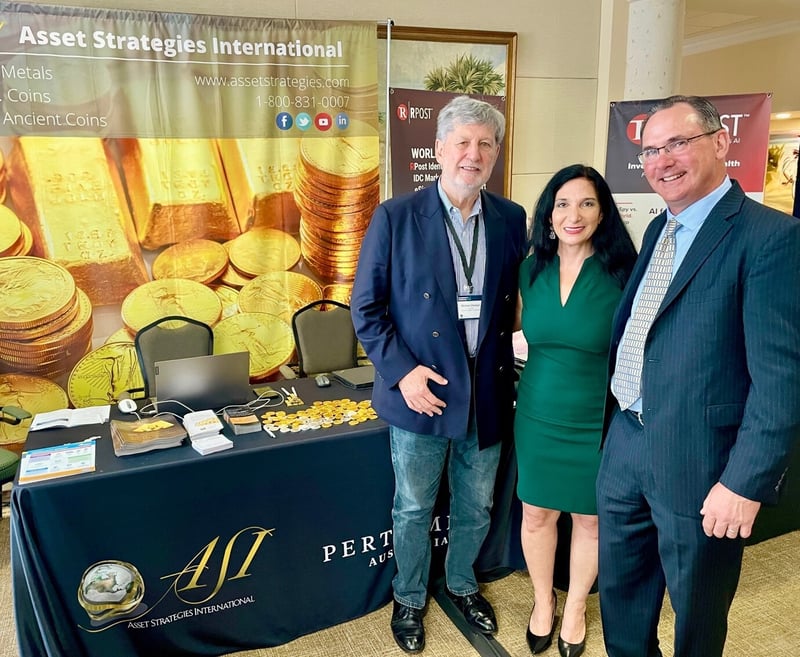
It's an honor to share these insights with you.
Gold
2025
Gold first broke above $4,000 an ounce on October 8, 2025. It broke $4500 on Christmas Eve. That pattern was largely due to ongoing central bank buying regardless of price, renewed Western retail interest, and six months of gold-ETF inflows.
Central banks bought approximately 950–1,050 metric tons of gold in 2025, or roughly 25% of total global gold demand. Yet, the global mine supply of about 3,700 tons, was up only about 1% year-on-year and remained below its 2018 peak, causing a structural deficit.
2026
Gold supply in 2026 remains constrained. The large mines that added capacity over the past two years, including Gold Fields' Salares Norte in Chile, the Greenstone project in Canada, and B2Gold's Goose project in Canada (which enters commercial production in 2026, ramping toward a planned capacity of roughly 300,000 ounces per year) were not enough to materially change global gold supply.
Global production is forecast to rise about 3,720–3,750 tons, according to research from Deutsche Bank. That increase amounts to 20–40 tons at most. Central banks alone have been absorbing close to 1,000 tons per year. To put this in perspective, the entire expected increase in mine supply for 2026 can be absorbed in a matter of weeks at the current buying pace.
We remain positive on gold as an anchor to any long-term investment portfolio, major miners with good cash balance sheets and geographically dispersed junior miners.
Silver
2025
Silver ended the year at $72, having hit an intraday record high of $83.62 in late December 2025. What made 2025 so pivotal for silver's future prospects was the specific cocktail of factors driving the price. Industrial demand is at record highs. Current supply is running a five-year structural deficit. And governments are spending or planning to spend at record scale to rebuild power grids and energy infrastructure, which requires silver.
2026
That supply gap leaves the market exposed to accelerating demand. Plus, the majority of global silver is a by-product of copper, lead, and zinc mining. That means silver supply cannot respond directly to higher silver prices and related financial support.
China, one of the world's largest silver refiners and consumers, expanded its export controls and licensing conditions across strategic metals and refined materials on Jan. 1, 2026. These directives will amplify uncertainty surrounding future silver flows.
Existing silver mines are facing declining ore grades, meaning more material must be mined to yield the same amount of silver. Developing new primary silver mines can take up to 8-12 years due to permitting challenges and significant capital requirements. There are no major additions expected in the near term, as we've reported. This backdrop of tight supply and rising demand will push prices higher and favor miners closer to high quality production.
We expect silver to rally more than 50% from these levels by the end of 2026. In addition to physical silver, we favor investing in junior miners in neutral jurisdictions for long-term opportunities.
Platinum
2025
Platinum carries the precious-metal label, but its demand is driven primarily by physical need rather than by macro variables such as inflation trends or currency shifts.
The World Platinum Investment Council forecast a 700,000-ounce deficit for 2025, after deficits in 2023 and 2024. Plus, Platinum does not have a diversified global production footprint. About 70% of mined supply comes from South Africa and 10-12% from Russia.
In South Africa, power instability at state-owned utility Eskom impacted output. Several producers lowered their 2026-2028 guidance levels due to power issues and rising costs. Above-ground supply sits at the lowest levels in half a decade. That means any disruption in mine output or refined metal flow will directly impact prices.
2026
This year's platinum demand is already baked into the 2026 production plan and automakers' manufacturing pipelines, leaving little buffer room for supply disruptions as it is. What can move prices upward is problems with regional outflow.
The new U.S. "Phase 3" emissions-control rules for heavy-duty vehicles, petrochemical facilities, and refinery operations will expand the load on PGMs. Europe's Euro 7 rules tighten emissions limits for new light-duty trucks in 2026 and for heavy-duty ones in 2027. This means catalytic systems must do more work and rely more heavily on PGMs to do it.
This is the fundamental disconnect heading into 2026. The regulatory framework is getting stricter as mine supply is becoming less reliable. Demand for 2026 will increase due to regulatory, contractual, and scheduled plans. But supply can't yet keep up.
The Western Hemisphere is increasingly strategic for PGMs.
As a result, we see upside in physical platinum as well as North and South American Platinum Group Metals (PGM) miners for 2026.
I wish you all a fantastic 2026 filled with solid investing and learning. For those of you that want more analysis on specific mining opportunities, we would welcome you to our Prinsights Newsletters, at any tier that works best for you.
Click here for details and a special 10% discount off an annual subscription to our Premium product for the ASI community.
Editor's Note: Jim Woods is the editor of Investing Edge, Bullseye Stock Trader, Fast Money Alert and his latest publication, Crypto & Commodities Trader. A self-described radical for capitalism, he celebrates the virtue of making money from his Southern California horse ranch. You can read more of his work here.
The Inside Story
Don’t Buck the Wisdom of a Bull Crowd
By Jim Woods
About two decades ago a book hit the public consciousness titled, “The Wisdom of Crowds: Why the Many Are Smarter Than the Few and How Collective Wisdom Shapes Business, Economies, Societies and Nations.” The book, written by James Surowiecki, was basically a series of anecdotes illustrating how the aggregation of information in groups often resulted in decisions that achieved better outcomes than could have been made by any single member of the group.
When this book came out the individualist in me became somewhat alarmed, as my experience has been that the collective is no match for the innovative individualist. And while this individualist bias, admittedly fueled by my fondness for Ayn Rand novels “The Fountainhead” and “Atlas Shrugged,” has served me and the world exceedingly well, I will acknowledge that there is a case that can be made for the wisdom of crowds.
Indeed, the stock market itself is a kind of future pricing machine that represents the wisdom of crowds, as investors are making decisions on their own, and the collective wisdom of the investing crowd tells us whether that money is going to the proper place. Now, every year about this time, we start to see the collective prognostications of the crowd of experts, me included, who are tasked with the job of trying to assess what the markets will do in the year to come. Consider it an annual tradition of sorts in this business, as a new calendar year means it’s time to reveal the outlooks and market predictions from experts and investment banks, outlooks that are sometimes prescient, frequently off the mark, and often just plain obvious.
Still, putting on one’s prognostication hat is a valuable exercise and thought experiment of sorts, because it impels us to look at the current market environment and see what forces are likely to shape the markets and the economy in the 12 months to come. Sometimes the experts get it right, and sometimes we get it wrong (yes, that includes me). Hey, no man or organization is infallible, despite the wisdom of the crowds, and the reason why we can’t be certain about what’s to come in markets is because human behavior and human action is not predictable in the details.
Yes, there are general principles of human action we can use as the basis of our assessment. The great Austrian economist Ludwig von Mises called this study of the principles “praxeology,” which essentially posits that individuals act intentionally to alter an unsatisfactory state, using scarce means to reach desired ends. Yet the details of this human action are so varied and so voluminous that keeping track of it all is virtually impossible. Yet what isn’t impossible (albeit it is difficult) is to project out what we think might happen going forward based on the data we have now.
On that front, I’ve read multiple 2026 market outlooks, and the consensus opinion is that the 2025 bull will continue running in the year to come. According to my research, Wall Street strategists are forecasting a median gain of between 11% to 17% for the S&P 500. From the levels at the time those forecasts (~6,834), that would bring those targets to a range of approximately 7,585 to 8,000 by year-end.
Primary drivers of this bullish outlook are continued strong corporate earnings growth, particularly from the artificial intelligence (AI) boom, and those much-anticipated interest rate cuts by the Federal Reserve, which are likely to continue in the year to come, especially given that President Trump is going to appoint a new Fed chair that will be much more “dovish” i.e., more willing to lower interest rates, than current Fed Chair Jay Powell.
Of course, every potential positive comes with a potential negative, because economic growth and earnings growth are never guaranteed. If the broader economy begins to contract, or if earnings growth contracts, that will be a headwind blowing strongly in the face of the bulls. On the AI front, we witnessed that trade come back to reality in the final six weeks of 2025, as so-called “AI skepticism” has become a fear embedded into the market.
One assessment/outlook for 2026 that I found particularly interesting comes from Goldman Sachs (the best firm on Wall Street, in my opinion). One subtitle in the 2026 outlook is, “Equities in a Multipolar World.” Apart from the witty wordplay, I found this commentary interesting, and worth the read. Goldman basically argues the following:
The global economic and geopolitical environment is adopting a more multipolar structure, in our view, resulting in greater fragmentation and a broader array of opportunities for equity investors.
The US stock market continues to be driven by advancements in and investor sentiment towards AI, with leading companies harnessing technology and scale to achieve remarkable growth.
We believe maximizing equity diversification and managing risk effectively is essential given the investment backdrop. In our view, this can be achieved through active exposure, a global presence, and regional expertise; combined with a strategic blend of fundamental and quantitative equity strategies.
I concur with this view, and I also believe that maintaining an “Investing Edge” through diversification, risk management, active exposure in the best-of-breed stocks selected via a blend of fundamental and quantitative strategies will be the approach that provides that edge, even if those consensus bullish Wall Street forecasts fail to come to fruition.
If you want to harness the power of that “Investing Edge,” then my newsletter of the same moniker is just for you.
|